
 Deutsch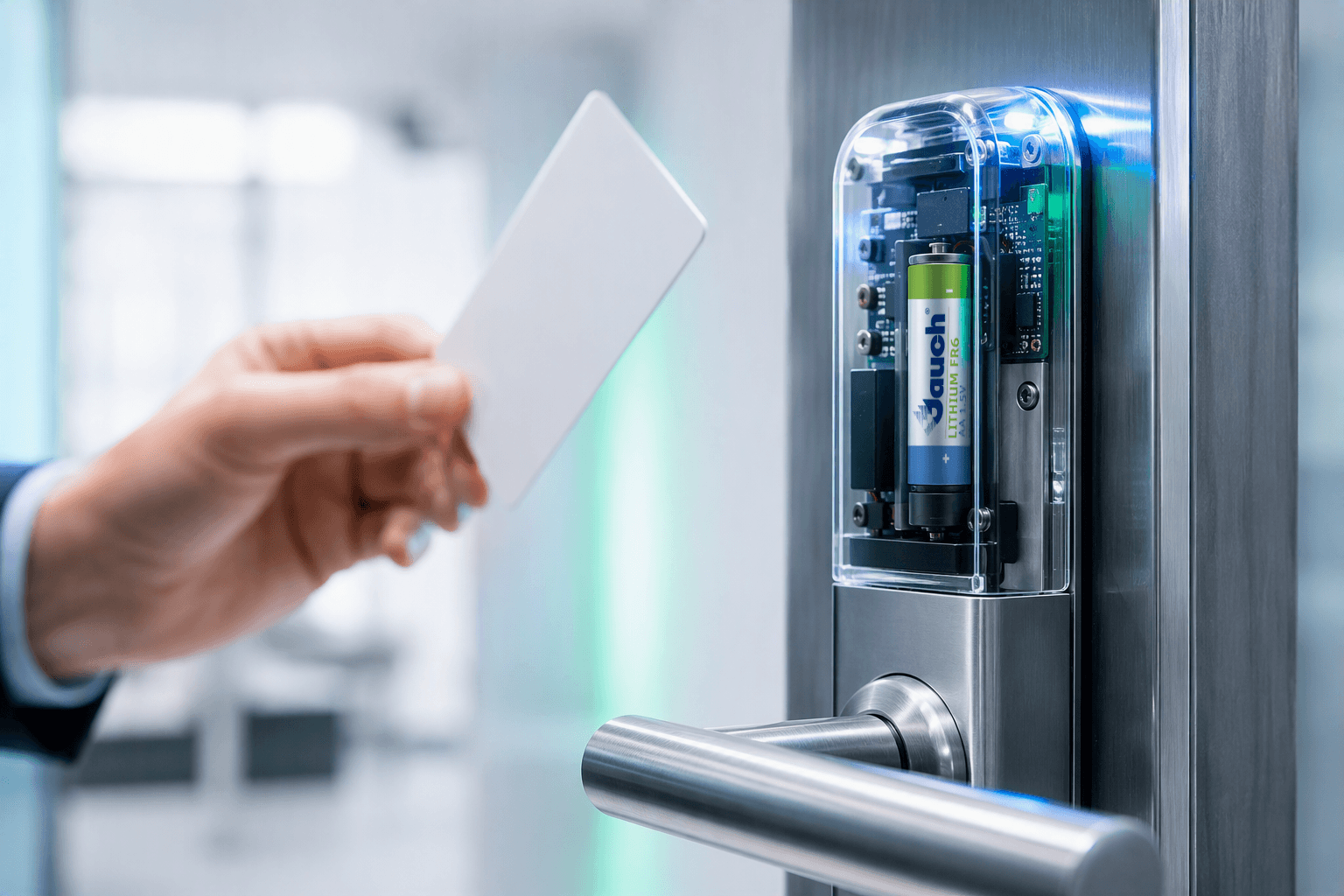
Which Battery Is Best Suited for Access Control Systems? A Comparison of FR, CR, ER, and Lithium Coin Cell Batteries
The selection of the right Battery for access control systems and electronic locking cylinders has a significant impact on service life, maintenance requirements, and overall application reliability. Depending on the specific requirements, different battery chemistries may be used, including Lithium Iron Disulfide (FR), Lithium Manganese Dioxide (CR), Lithium Thionyl Chloride (ER), and Lithium Coin Cell Batteries.
The power supply must operate reliably over extended periods, even under varying temperatures and irregular usage patterns. For many access control and entry management applications, Lithium Iron Disulfide Batteries (FR) are therefore a particularly suitable solution.
Lithium Iron Disulfide Batteries (FR) as a Robust Primary Chemistry for Access Control Systems
With FR03 in the AAA format and FR6 in the AA format, Jauch offers Lithium Iron Disulfide Batteries with a nominal voltage of 1.5 V. They are designed as a high-performance alternative to conventional Alkaline Batteries and are particularly well suited for applications with long operating cycles or elevated power requirements.
A stable voltage profile is especially critical in electronic locking systems. FR Batteries feature a flat discharge curve, enabling the output voltage to remain at a consistently high level for extended periods, even under load. This ensures the reliable operation of electronic components, including during peak load conditions. At the same time, their low internal resistance supports high pulse currents, which are often required for wireless modules, motors, and actuators.
Another advantage is the wide operating temperature range of –40°C to +60°C. This makes FR Batteries an excellent choice for access control solutions used in outdoor environments, unheated buildings, or industrial settings. Their high energy density, stable voltage profile, and strong pulse current capability help extend Battery life and reduce maintenance requirements. As a result, longer service intervals and greater overall system reliability can be achieved.
Why FR Batteries Outperform Alkaline Batteries in Many Electronic Locking Systems
Many electronic locking systems rely on replaceable Batteries in standard sizes. In these applications, FR03 and FR6 offer significant advantages over alkaline Batteries, including longer operating life, improved performance under load, low self-discharge, and reliable operation even at low temperatures.
Another important benefit is safety. Alkaline Batteries may leak when fully discharged, potentially damaging contacts and electronic components. This behavior is uncommon with Lithium Iron Disulfide Batteries, significantly reducing the risk of damage to Battery holders and electronic assemblies. In addition, replacement Batteries can be stored for extended periods and kept in inventory, simplifying maintenance, particularly in large-scale access control installations.
Alternative Battery Solutions for Specialized Requirements
Despite the many advantages of FR Batteries, some applications are better served by alternative cell chemistries. “In addition to Lithium Iron Disulfide Batteries, Lithium Thionyl Chloride Batteries (ER), cylindrical Lithium Manganese Dioxide Batteries (CR), and Lithium Coin Cell Batteries are also used in access control applications,” explains Jérémie Melfi, who supports numerous projects in this field at Jauch.
Lithium Manganese Dioxide Batteries (CR)
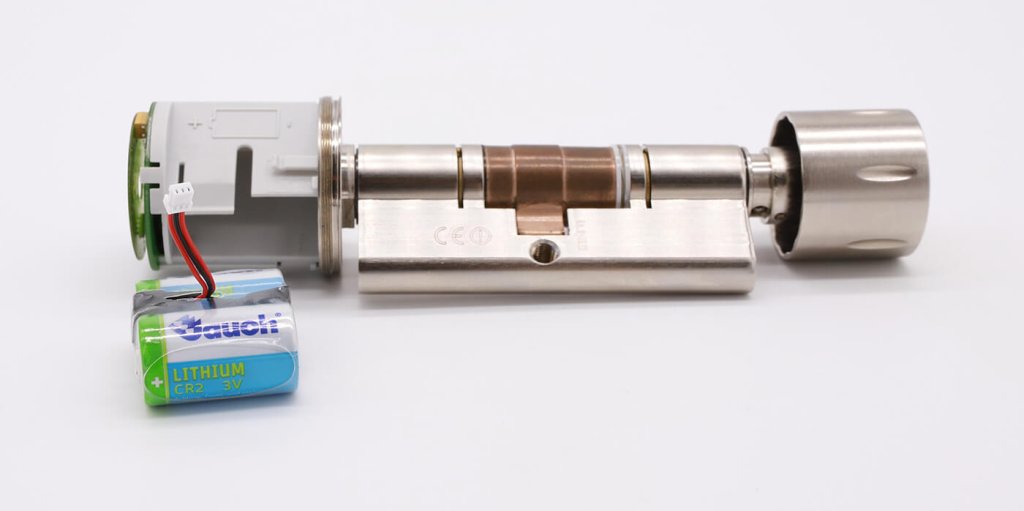
Many electronic locking cylinders continue to use CR2 Batteries. With a nominal voltage of 3 V, they are particularly well suited for applications with specific requirements regarding voltage, form factor, or pulse performance. If the capacity of a single cell is not sufficient, custom Battery Packs can also be used.
performance alternative to conventional Alkaline Batteries and are particularly well suited for applications with long operating cycles or elevated power requirements.
A stable voltage profile is especially critical in electronic locking systems. FR Batteries feature a flat discharge curve, enabling the output voltage to remain at a consistently high level for extended periods, even under load. This ensures the reliable operation of electronic components, including during peak load conditions. At the same time, their low internal resistance supports high pulse currents, which are often required for wireless modules, motors, and actuators.
Another advantage is the wide operating temperature range of –40°C to +60°C. This makes FR Batteries an excellent choice for access control solutions used in outdoor environments, unheated buildings, or industrial settings. Their high energy density, stable voltage profile, and strong pulse current capability help extend Battery life and reduce maintenance requirements. As a result, longer service intervals and greater overall system reliability can be achieved.
Why FR Batteries Outperform Alkaline Batteries in Many Electronic Locking Systems
Many electronic locking systems rely on replaceable Batteries in standard sizes. In these applications, FR03 and FR6 offer significant advantages over alkaline Batteries, including longer operating life, improved performance under load, low self-discharge, and reliable operation even at low temperatures.
Another important benefit is safety. Alkaline Batteries may leak when fully discharged, potentially damaging contacts and electronic components. This behavior is uncommon with Lithium Iron Disulfide Batteries, significantly reducing the risk of damage to Battery holders and electronic assemblies. In addition, replacement Batteries can be stored for extended periods and kept in inventory, simplifying maintenance, particularly in large-scale access control installations.
Alternative Battery Solutions for Specialized Requirements
Despite the many advantages of FR Batteries, some applications are better served by alternative cell chemistries. “In addition to Lithium Iron Disulfide Batteries, Lithium Thionyl Chloride Batteries (ER), cylindrical Lithium Manganese Dioxide Batteries (CR), and Lithium Coin Cell Batteries are also used in access control applications,” explains Jérémie Melfi, who supports numerous projects in this field at Jauch.
Lithium Manganese Dioxide Batteries (CR)
Many electronic locking cylinders continue to use CR2 Batteries. With a nominal voltage of 3 V, they are particularly well suited for applications with specific requirements regarding voltage, form factor, or pulse performance. If the capacity of a single cell is not sufficient, custom Battery Packs can also be used.
Lithium Thionyl Chloride Batteries (ER)
Lithium Thionyl Chloride Batteries are frequently used in applications that require exceptionally long operating life and low to moderate current consumption. They are characterized by high energy density, very low self-discharge, and a cell voltage of 3.6 V. Electronic locking cylinders are among the most common applications for this technology.
Lithium Coin Cell Batteries
Compact electronic locking systems with low power consumption frequently use Lithium Coin Cell Batteries. They require very little installation space and can be replaced easily.
What Is a Chemical Switch in CR2 Batteries?
When using CR2 Batteries, it is also important to distinguish between consumer and industrial Batteries. Many consumer-grade cells feature a so-called Chemical Switch. This protective mechanism can abruptly shut down the Battery once it falls below a defined voltage threshold. Such behavior is undesirable in locking systems, as an electronic locking cylinder must operate reliably at all times. Industrial Batteries therefore do not incorporate this mechanism, making them a better choice for safety-critical applications such as electronic locking cylinders and access control systems.
Conclusion: FR Batteries Are the Preferred Choice for AA- and AAA-Based Access Control Solutions
For many access control systems, electronic locking cylinders, and door locks, Lithium Iron Disulfide Batteries (FR) are the preferred choice. They offer long operating life, reliable power delivery, and a high-performance alternative to conventional Alkaline Batteries in access control and entry management applications.
Depending on power consumption, required operating life, available installation space, and environmental conditions, CR2 Batteries, ER Batteries, Lithium Coin Cell Batteries, or custom Battery Packs may also provide the optimal solution.