
 Deutsch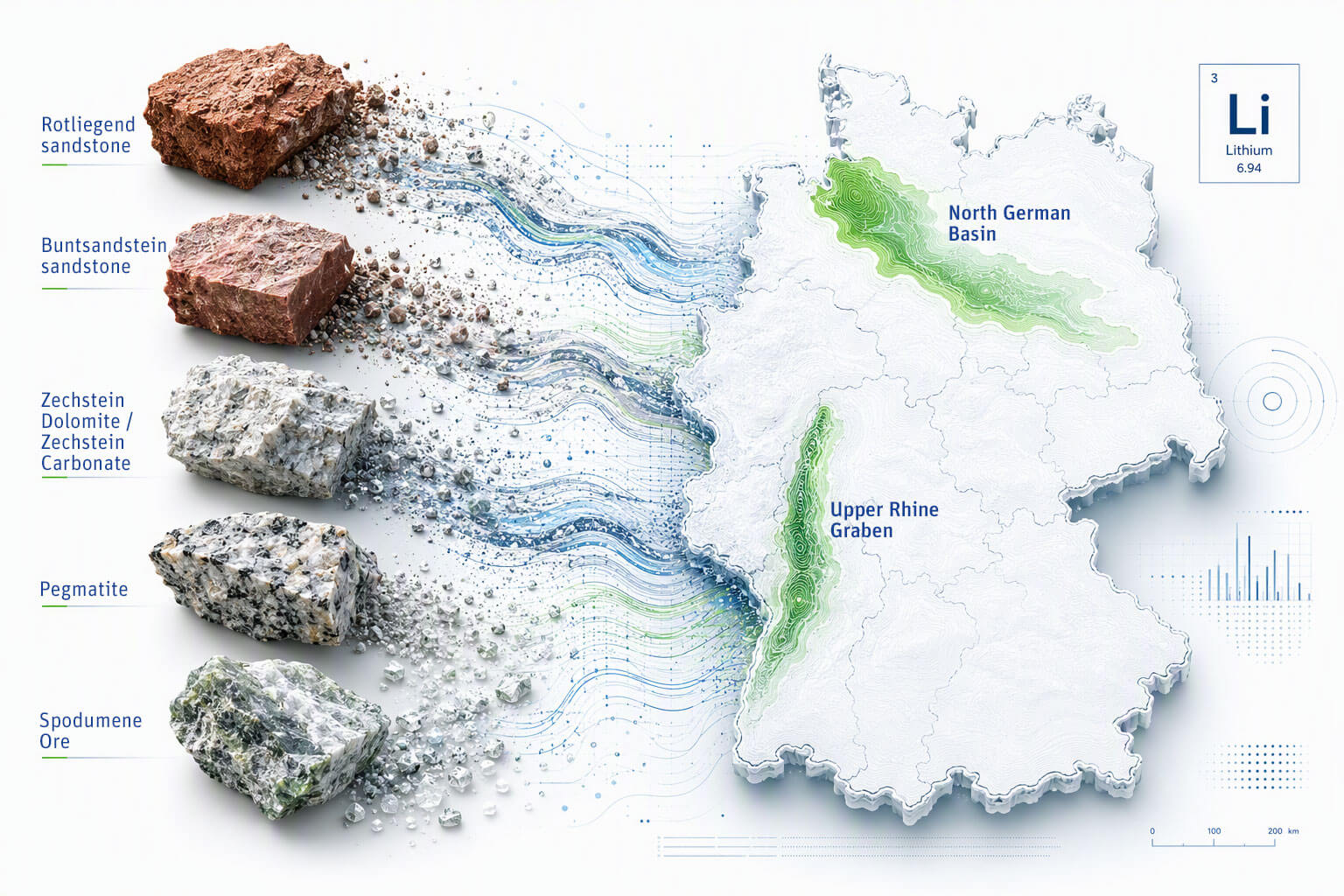
Lithium-bearing rocks include Buntsandstein sandstone, Rotliegend sandstone, Zechstein dolomite/Zechstein carbonate, pegmatite, and spodumene ore, among others
How Lithium Can Be Extracted from Deep Thermal Water
Securing a reliable supply of lithium is one of the key challenges facing the Battery industry. While a large share of the raw material required for Lithium-Ion Batteries currently comes from South America, Australia, and China, researchers and industry leaders are exploring alternative lithium sources in Europe.
A recent technical article published by ElektronikPraxis examines an intriguing question: Could lithium be extracted from geothermal sources in the future? The article refers to a recent study conducted with the participation of the Fraunhofer IEG and focuses on regions such as the Upper Rhine Graben and the North German Basin. These geological formations contain deep, mineral-rich thermal water reservoirs that could potentially provide both geothermal energy and lithium for Battery production in the years ahead.
Read the full article here:
➡️ Could Geothermal Energy Provide Battery Raw Materials in the Future?
We spoke with Sönke Zacher, Legal Counsel and Head of Battery Project Management at Jauch, to get his perspective.
Jauch: Mr. Zacher, why is lithium from geothermal sources attracting so much attention right now?
Sönke Zacher: Europe remains heavily dependent on lithium imports. Extracting lithium from geothermal sources could help establish regional supply chains and diversify the supply of this critical raw material.
Jauch: What benefits could this offer the European Battery industry?
Sönke Zacher: Regional lithium sources could improve supply security, shorten transportation routes, and reduce dependence on imports.
Jauch: How is lithium technically extracted from geothermal sources?
Sönke Zacher: Lithium is not extracted directly from rock but from lithium-rich thermal water pumped from depths of several thousand meters. The lithium contained in the water is recovered using specialized extraction processes. The thermal water is then reinjected into the geological formation. This approach makes it possible to combine geothermal energy generation with lithium production.
Jauch: What challenges still need to be addressed?
Sönke Zacher: A key factor will be whether these extraction processes can be successfully implemented on an industrial scale from both a technical and economic perspective.
Whether these methods will prove viable in the long term depends on their scalability and economic feasibility. For the Battery industry, however, such developments are highly relevant, as they could open up new opportunities for regional raw material sourcing.
Looking beyond lithium extraction alone is not enough. The security of supply for the European Battery industry depends on the entire value chain. While approximately 52% of the world’s lithium is currently mined in Australia, around 73% of the processing required to produce Battery-grade materials takes place in China. Dependence is even more pronounced when it comes to other key materials: China processes approximately 72% of the world’s cobalt, 95% of its manganese, and nearly 100% of the graphite used in modern Lithium-Ion cells.
China also dominates the supply chain for the components that are critical to cell manufacturing. Around 71% of cathode materials and 91% of anode materials originate there. To build a more resilient European Battery industry, equal attention must be paid to raw material extraction, material processing, and cell manufacturing.
As highlighted in our white paper “Safe Handling of Lithium Batteries” we have previously explored the importance of regional lithium sources and lithium extraction in Germany.
The extraction of lithium from geothermal sources alone will not be sufficient to meet global demand for raw materials. However, as an additional source of lithium, it could help diversify Europe’s raw material supply and reduce dependencies across the supply chain.
*The featured image was created using artificial intelligence.