
 Deutsch
Which products are affected, which exemptions apply, and why manufacturers should already be designing for Battery replaceability
The European Battery Regulation (EU) 2023/1542 has been in effect since February 18, 2024. Many companies are already addressing labeling requirements, technical documentation, conformity assessments, and new information obligations. However, additional requirements will be introduced gradually.
An important milestone will take effect on February 18, 2027. From that date onward, many battery-powered products will be subject to new requirements regarding the replaceability of the Battery used. As a result, the Regulation will have a direct impact on product development.
For general information about the Battery Regulation, please refer to our existing articles:
- The New European Battery Regulation EU 2023/1542: What You Need to Know
- One Year of the New European Battery Regulation EU 2023/1542: An Interview with Sönke Zacher
What Does the EU Require Starting in February 2027?
The new requirements are intended to ensure that replacing a worn-out Battery does not force consumers to replace an otherwise fully functional device. As a result, future Battery accessibility will become a key consideration in the development of new products.
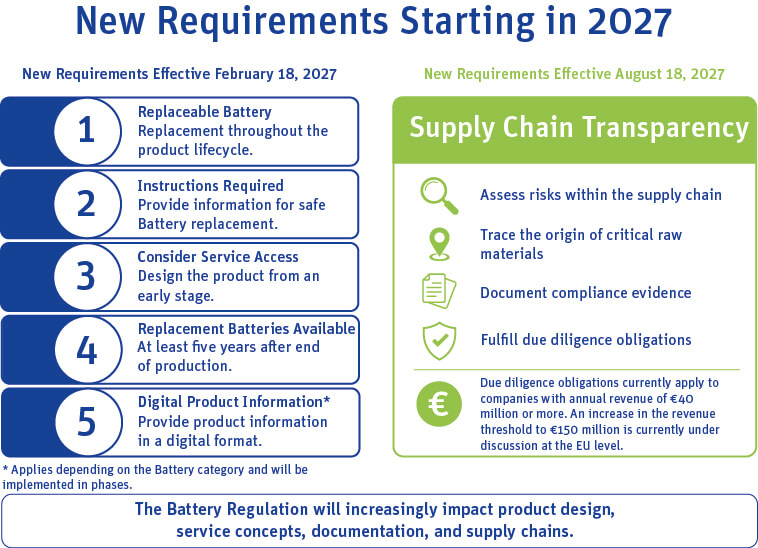
Starting February 18, 2027, portable Batteries must generally be removable and replaceable throughout the product’s lifetime. For Batteries used in light means of transport such as e-Bikes and e-Scooters, replacement must be possible by independent professional repairers. For device manufacturers, the key requirements include:
- Consider Battery replacement during product design
- Ensure the Battery is integrated in an accessible manner
- Provide instructions and safety information
- Enable safe Battery replacement
- Ensure the availability of compatible replacement Batteries
Sönke Zacher, Senior Project Manager Battery Solutions at Jauch, explains the impact: “Many companies are currently focused primarily on documentation and labeling requirements. However, the replaceability requirements demonstrate that the Battery Regulation is increasingly having a direct impact on technical product design.”
Why Was This Regulation Introduced?
Built-in Batteries often make repairs more difficult and can limit the service life of a product. The EU therefore aims to make Battery replacement easier, extend the lifespan of devices, and reduce unnecessary electronic waste. At the same time, the Regulation is intended to strengthen recycling efforts and promote a circular economy.
Which Devices Are Affected?
The requirements are particularly relevant for products powered by portable Batteries. These Batteries are used in a wide range of applications, including sensors and IoT devices, Smart Home products, measurement and testing equipment, access control systems, and portable industrial electronics. Correct classification within the applicable Battery category is essential. The category determines which requirements apply and who must be able to replace the Battery at a later stage.
Why Is the New Requirement Causing Discussion?
While the overall objective of the Regulation is clear, several questions regarding its practical implementation remain open. These include the treatment of permanently integrated Batteries, sealed or bonded enclosures, and the distinction between portable Batteries and industrial Batteries. The conditions under which exemptions may apply are also currently the subject of extensive discussion.
Sönke Zacher explains: “Companies that address these requirements only shortly before market launch risk costly redesigns and delays. Battery replaceability should therefore be considered during the early stages of product development.”
What Impact Will This Have on Product Development?
Battery replaceability affects far more than enclosure design alone. Mechanical, electrical, and service concepts must be carefully aligned to ensure that the Battery remains safely accessible and replaceable without compromising structural integrity, ingress protection, or operational safety. Particularly in compact or sealed devices, manufacturers often face competing requirements involving robustness, product lifetime, ease of use, and serviceability.
Replacement Batteries: A Frequently Overlooked Requirement
Battery replaceability does not end with product design. Under Article 11(7) of the Battery Regulation, compatible replacement Batteries must generally remain available for at least five years after the last unit of a device model has been placed on the market. Manufacturers should therefore consider long-term Cell availability, an appropriate spare parts strategy, and the required documentation already during the development phase. As a result, the regulatory requirements extend well beyond a product’s release to market.
What Exceptions Apply?
Not every product allows a Battery to be replaced easily by the end user. Specific safety requirements, protection against water ingress, or particular operating conditions may require alternative solutions. The Regulation therefore provides for exemptions and special provisions. However, these must be technically justified and clearly documented for the respective product.
Starting in August 2027, Supply Chain Requirements Will Also Come into Focus
While the requirements taking effect in February 2027 primarily concern product design, another regulatory milestone will follow in August 2027. At that point, due diligence obligations throughout the supply chain will become relevant for affected companies.
The focus will be on the raw materials Lithium, Cobalt, Nickel, and Natural Graphite. Companies will be required to assess risks within their supply chains, establish appropriate processes, and maintain transparent documentation regarding the origin and processing of relevant raw materials. As a result, product development, procurement, quality management, and compliance teams will need to work even more closely together in the future.
At present, these due diligence obligations apply only to larger companies with annual revenue exceeding €40 million. However, the EU is currently considering raising this threshold to €150 million. As a result, the group of affected companies could change in the future.
Conclusion: Integrate Requirements into Projects at an Early Stage
The requirements taking effect in 2027 extend far beyond the Battery as a standalone component. They impact the entire product lifecycle, from mechanical design and electrical safety to spare parts availability and supply chain documentation. Companies should therefore address the following questions at the beginning of every project:
- Which Battery category applies?
- Who must be able to replace the Battery?
- What design modifications are required?
- Does a justified exemption apply?
- How will long-term spare parts availability be ensured?
- What information is required from the supply chain?
As a result, the key development question is changing: It is no longer just about selecting the Battery that best meets the technical requirements of the application. Equally important is ensuring that the Battery can be integrated into the overall system in a safe, serviceable, and regulatory-compliant manner.
Note: This article provides a general technical and regulatory overview. It does not constitute legal advice.
*The featured image was created using artificial intelligence.