
 Deutsch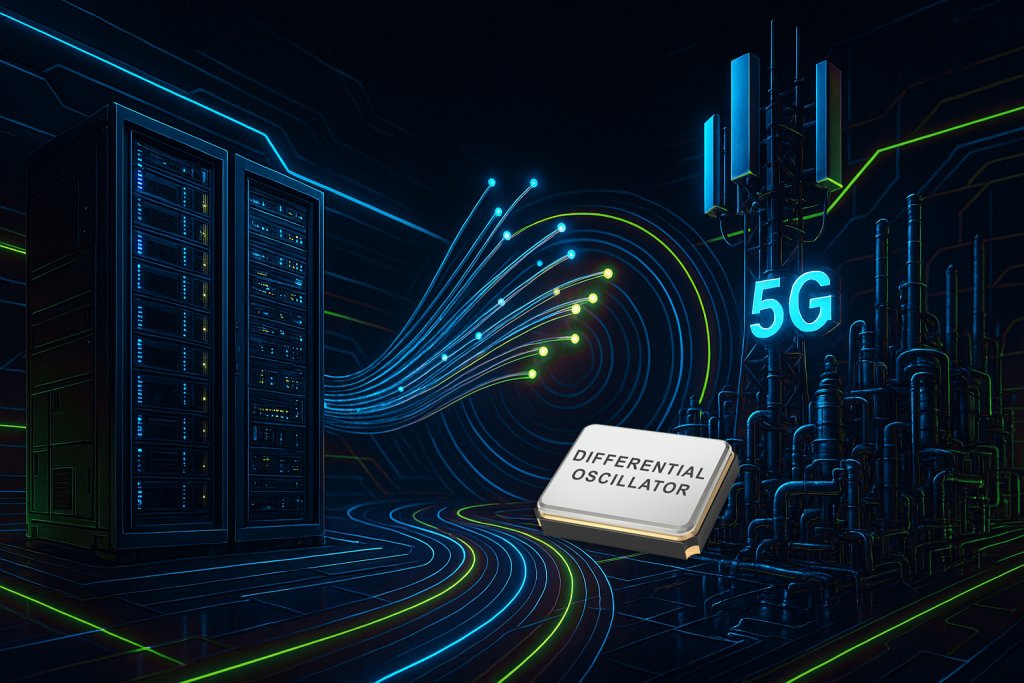
While modern electronic systems—from data centers and telecommunications to industrial control systems—rely on precise clock signals, ultra low jitter oscillators from Jauch provide optimal solutions. In addition, they deliver extremely low phase jitter. Moreover, they minimize common-mode noise. As a result, these oscillators ensure maximum signal integrity. Even at high data rates and in interference-prone environments, they perform reliably.
What are Differential Oscillators?
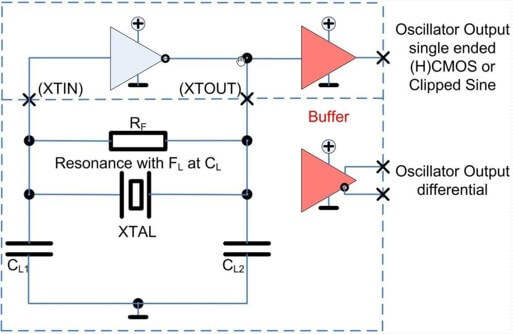
Two complementary output signals are generated by differential oscillators with a 180° phase shift. Unlike classic single-ended outputs such as CMOS or TTL, they offer significantly higher noise immunity. They also provide faster switching times and lower electromagnetic interference (EMI). The most important output logics are HCSL, LVDS, and LVPECL.
What distinguishes Differential Oscillators from Conventional Oscillators?
Differential signal transmission effectively suppresses common-mode noise, significantly improving signal integrity and reliability, particularly at high data rates. Moreover, this design is less susceptible to external interference. It enables error-free data transmission. Precise synchronization is possible—even in complex and demanding electronic environments.
Advantages of Differential Oscillators
- Minimized jitter and phase noise: Differential oscillators achieve phase jitter values of up to 60 fs rms (at 156.25 MHz), crucial for error-free data transmission and precise synchronization in high-speed networks.
- High interference immunity: Differential signal transmission suppresses common-mode interference and ensures stable performance even in electrically noisy environments.
- Optimal signal integrity: Complementary output signals minimize reflections and ringing on transmission lines, increasing reliability.
- Flexible supply voltages and compact designs: Ideal for space-critical designs and modern high-frequency applications.
- Wide temperature range and high frequency stability: The oscillators are designed for use from –40°C to +105°C (optionally up to +125°C) with overall stability of ±50 ppm to ±100 ppm.
Output logic in detail: HCSL, LVDS, LVPECL
HCSL (High-Speed Current Steering Logic):
HCSL is a differential output format with a typical voltage swing of approximately 700 mV. It is characterized by fast rise/fall times and high noise immunity. HCSL is preferred for PCI Express applications, servers, and interface cards. The output signal shape is virtually independent of the supply voltage, making it particularly suitable for peripherals and interfaces based on modern chipsets.
LVDS (Low Voltage Differential Signaling):
LVDS operates with a low voltage swing of approximately 350 mV and is characterized by minimal power consumption, low electromagnetic interference, and excellent noise suppression. LVDS is the preferred interface for network switches, routers, wireless base stations, and video technology. The low amplitude enables high speed with low driver current.
LVPECL (Low Voltage Positive Emitter-Coupled Logic):
LVPECL offers a voltage swing of approximately 800 mV and is designed for applications with the highest requirements for speed and signal integrity. The output transistors operate without complete shutdown, resulting in low phase noise values and fast switching times. LVPECL is ideal for network switches, routers, and optical transmission systems.
Differential Oscillators at Jauch
For applications where maximum precision and minimal signal interference are crucial, Jauch offers tailor-made solutions with its JOx21 and JOx22 series of ultra-low jitter oscillators. These miniature oscillators feature exceptionally low phase jitter of up to 60 fs rms (at 156.25 MHz), ensuring error-free and stable data transmission—even at the highest transmission rates and in demanding environments such as data centers, 5G infrastructure, or optical communication modules.
Jauch’s JOx21 and JOx22 series of ultra-low jitter oscillators are available in compact SMD packages and support various differential output logics (HCSL, LVDS, LVPECL). They offer high frequency stability (up to ±50 ppm) and a wide operating temperature range (–40°C to +105°C, optionally up to +125°C). Thanks to their versatility and performance, these ultra-low jitter oscillators are ideal for space-critical designs and modern high-frequency applications.
Key Differential Oscillators from Jauch:
- JOH21: HCSL output, ultra-low jitter, ideal for PCIe, servers, interface cards, high-speed interfaces
- JOE21: LVPECL output, ultra-low jitter, optimal for network and telecommunications applications such as network switches, routers and optical modules
- JOD21: LVDS output, ultra-low jitter, suitable for Ethernet, storage devices, IoT, optical transmission and industrial applications
Common Characteristics:
- Phase jitter: up to 60 fs rms (at 156.25 MHz)
- Frequency range: 100.0–160.0 MHz (other frequencies available on request)
- Frequency stability: up to ±50 ppm
- Supply voltages: 1.8 V, 2.5 V, 3.3 V (depending on model)
- Temperature range: –40°C to +105°C (optionally up to +125°C) • Compact SMD packages for space-saving designs
Areas of Application for low-jitter oscillators
Differential oscillators from Jauch are designed for demanding high-speed applications requiring maximum precision and reliability. Typical areas of application include:
- Telecommunications and network technology:
Synchronization of network switches, routers, and base stations in 5G infrastructures, Ethernet (100G–800G), and optical transmission modules. The oscillators ensure stable clocking and minimize data loss at high transmission rates. - Data centers and servers:
Distribution of clock signals across server farms and storage systems, efficient data processing and storage, timing solutions for cloud computing and SSD storage. - Industry and embedded systems:
Use in FPGA-based designs, test and measurement systems, industrial controllers, and workstations where reliable and interference-free signal transmission is crucial. - Video and audio technology:
Precise timing for digital TV sets, set-top boxes, audio/video streaming, and gaming systems. - IoT and edge computing:
Synchronization and data integrity in networked devices and sensors, particularly in applications with high demands on real-time processing and low latency.
Conclusion: Ultra-Low Jitter Oscillators from Jauch – Precision for High-Speed Applications
Differential oscillators are essential in modern high-speed applications. Extremely low phase jitter and maximum signal integrity set them apart. Reliability and flexibility reach new standards with this technology. Differential signal transmission minimizes interference. Precise synchronization is possible, even at the highest data rates. Data centers, telecommunications, and industry benefit greatly.
Jauch’s specially developed JOx21 and JOx22 series provide tailor-made solutions for uncompromising performance and space-saving designs. The combination of ultra-low jitter, wide frequency and temperature range, and versatile output logic is unique. Therefore, these features make the oscillators the first choice for future-oriented designs.
In 5G infrastructure, server farms, optical transmission modules, or industrial environments, Jauch’s differential oscillators ensure stable data transmission. Moreover, they are interference-free and efficient. This makes them indispensable for the next generation of electronic systems.
*Featured image was generated using artificial intelligence.